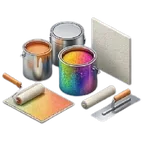
How much paint for a room depends on the surface area, the number of coats and the consumption rate of the specific product. Floor area alone does not tell you about the walls. Below, we calculate only the room's walls and leave the ceiling as a separate item on the shopping list.
How much paint for a room: measure the surfaces you will actually paint
Take an example room measuring 4 m long, 3 m wide and 2.7 m high. Its perimeter is 2 × (4 + 3) = 14 m. The total wall area is 14 × 2.7 = 37.8 m².
The door measures 0.9 × 2 m and the window 1.5 × 1.4 m. Subtract 1.8 + 2.1 = 3.9 m² of openings. This leaves 33.9 m². We do not paint the reveals in this example. If they are part of your work, measure them and add their area separately.
Walls are primed before puttying or painting; for the primer quantity see primer consumption per m².
Walls are usually puttied before priming and painting, so calculate the filler with finishing filler for walls.
Do not confuse consumption with coverage
Suppose the selected product covers 10 m² with one liter in one coat. This is an educational value, not a specification for all interior paints. Its consumption rate is 1 ÷ 10 = 0.1 L/m².
Two coats: 33.9 × 2 ÷ 10 = 6.78 L.
The 5% allowance selected for this example: 6.78 × 1.05 = 7.119 L.
Cans of 2.5 L: 7.119 ÷ 2.5 = 2.8476. Round up to 3 cans, totaling 7.5 L.
In the Budova calculator, enter consumption in L/m². For our assumption, the required value is 0.1, not 10. If the label gives g/m² or kg, do not equate mass with liters: use the density in the manufacturer's documentation or calculate your purchase in the units stated on the packaging.
For patterned wallpaper, see wallpaper with a pattern repeat.
Coats and allowances serve different purposes
The manufacturer Farbex explains how the substrate, tool and color change affect consumption. Take the number of coats from the instructions for your selected coating system. Our two coats do not guarantee the same result on every wall.
If the rate on the label already applies to a two-coat system, do not multiply it by two again. Likewise, the 5% in the example does not replace an adjustment for the actual substrate. Establish the consumption rate on a test area before ordering the full quantity.
Turn liters into a shopping list
After rounding, we have 7.5 L, which is 0.381 L more than the requirement including the allowance. Do not automatically add another 5% to the three cans. If other can sizes are available, compare their combined volume and actual store price. The smallest leftover does not always mean the lowest cost.
Prepare the room dimensions, openings, consumption per coat, number of coats and can sizes. Open the calculator below and enter your own data. Before purchasing, make sure that the units are correct and the ceiling or reveals were not counted twice.