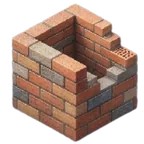
To work out how many bricks you need for a wall, first deduct the door and window openings. Then enter the brick format, masonry thickness, joint size and allowance. The same net area does not mean the same brick count with different formats or wall thicknesses.
How many bricks for a wall: record the dimensions and assumptions
For this worked example, we use a wall 5 m long and 3 m high. It contains one door opening of 1000 × 2000 mm and one window opening of 1500 × 1200 mm. The openings do not overlap and lie entirely within the wall. These are the dimensions of the openings in the masonry, not the size of the door leaf or glass.
We assume bricks measuring 250 × 120 × 65 mm, half-brick masonry 120 mm thick and a 10 mm joint. These are parameters for the arithmetic example, not a choice of load-bearing construction. The 5% allowance below is also an assumption, not a universal standard.
The 250 × 120 × 65 mm format appears in the Euroton facing brick table. Other dimensions are also listed. Match the length, width and height to the specifications of your exact product.
Deduct openings only once
| Element | Calculation | Area, m² |
|---|---|---|
| Wall before deducting openings | 5 × 3 | 15.00 |
| Door opening, 1 | 1000 ÷ 1000 × 2000 ÷ 1000 | 2.00 |
| Window opening, 1 | 1500 ÷ 1000 × 1200 ÷ 1000 | 1.80 |
| Total openings | 2.00 + 1.80 | 3.80 |
| Net masonry area | 15.00 − 3.80 | 11.20 |
In this calculation, each opening passes through the full wall thickness included in the estimate. Do not deduct a niche or partial recess as a through-opening. If you combine several walls in one schedule, assign each opening to its wall. Do not deduct it again from the overall total.
A similar calculation for blocks is in number of aerated concrete blocks for a wall.
Check this example in Budova
On the public brick masonry calculator, tested on November 15, 2026 without signing in, select the 250 × 120 × 65 mm format. Set the wall dimension unit to meters, length to 5, height to 3, half-brick thickness to 120 mm and joint size to 10 mm.
The excluded-area section uses millimeters for dimensions. Add a row of 1000 × 2000 with a quantity of 1 and a row of 1500 × 1200 with a quantity of 1. Make sure that both rows appear in the list. Set the allowance to 5%.
The screen shows a gross area of 15.000 m², an excluded area of 3.800 m² and a net area of 11.200 m². These decimal points reproduce the tested Ukrainian screen. The base quantity is 572 bricks, the allowance is 29 and the total is 601 pieces. The geometric masonry volume without an allowance is 11.20 × 0.12 = 1.344 m³.
Consumption by zones is covered in plaster for an uneven wall.
Where 572 and 601 come from
For these parameters, Budova uses an approximate base rate of 51 bricks per m² in its calculation explanation. This is a coefficient in the app model, not an exact count for every masonry layout. The base quantity is rounded up to whole pieces, and the allowance is rounded separately.
Base: 11.20 × 51 = 571.20 → 572 bricks.
Allowance: 572 × 0.05 = 28.60 → 29 bricks.
Total: 572 + 29 = 601 bricks.
Do not treat 51 as the exact reciprocal of the product of the dimensions. For an assumed repeating module with uniform 10 mm joints, 1 ÷ (0.260 × 0.075) gives approximately 51.282 bricks per m². This differs from the app's rounded base rate and also does not describe the layout of edge courses or cuts. In this article, 572 and 601 reproduce the Budova model specifically.
Do not transfer formats and joint sizes between products
For example, Wienerberger describes the UK format of 215 × 102.5 × 65 mm with a nominal 10 mm joint. These dimensions differ from our example. Do not use the count per m² from one format in an estimate for another. The example format remains 250 × 120 × 65 mm in every translation of this article.
Before purchasing, review the layout with its bond, corners, junctions, cuts and special units. The design determines lintels, reinforcement, load-bearing capacity and permissible wall thickness. This quantity calculation does not determine them. Openings reduce the area but do not remove these requirements.
Keep the original wall dimensions, opening list, exact brick format, masonry thickness and the allowance already included for your order. Ask your chosen supplier about packaging, delivery and the actual price. Do not add the same 5% again to the total of 601 pieces.